Contributing care experts.
Care professionals and specialists bringing practical knowledge to the shared library.

The policy exists. But it’s 40 pages long. Your team may not know where to look, what applies, or who to ask.And the person who’d normally know isn’t there.
Your organisation's approved policies. Now available through a simple conversation.
A question on shift
“How do I report a safeguarding concern?”
Illustrative question. Experience the real response in OpenDoc Voice.
Speak a question naturally.
Hear guidance drawn from approved policies.
Follow the answer back to its source.
Without language barriers
Understanding should never depend on which one you speak.
Ask in the language you understand best. Hear the answer in that language. The approved policy remains the source of the guidance.
The language changes. The approved source does not.
Behind the intelligence
A source citation is only the beginning. OpenDoc makes the people, review and governance behind its shared policy knowledge visible.
Care professionals and specialists bringing practical knowledge to the shared library.
Each shared library policy undergoes review by at least three experts before publication.
Source accountability
Follow the response back to the relevant approved policy and, where applicable, the expertise and review behind the shared library content.
Guidance designed to be grounded in your organisation's approved policies.
Inspect the policy cited in the answer and check the underlying guidance.
Explore named contributors and review records associated with shared library policies.
OpenDoc supports professional judgement. Follow local escalation procedures when guidance is unclear or urgent action is required.
Management intelligence
OpenDoc records questions and responses, giving authorised managers a way to review how staff seek policy guidance.
Where are staff seeking clarification?
Which subjects come up repeatedly?
Where might training or clearer guidance help?
Use interaction records responsibly, with appropriate access and staff privacy safeguards. These are potential review uses, not claims of automated analytics.The research behind the approach
Human-Augmented Collective Intelligence.
HACI places the collective knowledge, judgement and accountability of care professionals at the centre of AI design. OpenDoc Voice illustrates how that approach can make governed policy knowledge accessible to a workforce.
Frontiers in Digital Health
Human-Augmented Collective Intelligence (HACI): A Consolidated Framework for the Design, Evaluation and Governance of AI in Health and Social Care
Dr Chané Moodley & Dr Devan Moodley · Accepted 23 November 2026
Peer-reviewed conceptual framework by Health Connect researchers; not a comparative product-performance trial. Final formatted article forthcoming at time of drafting.
In the public record
Care-sector coverage of multilingual access to policy guidance.
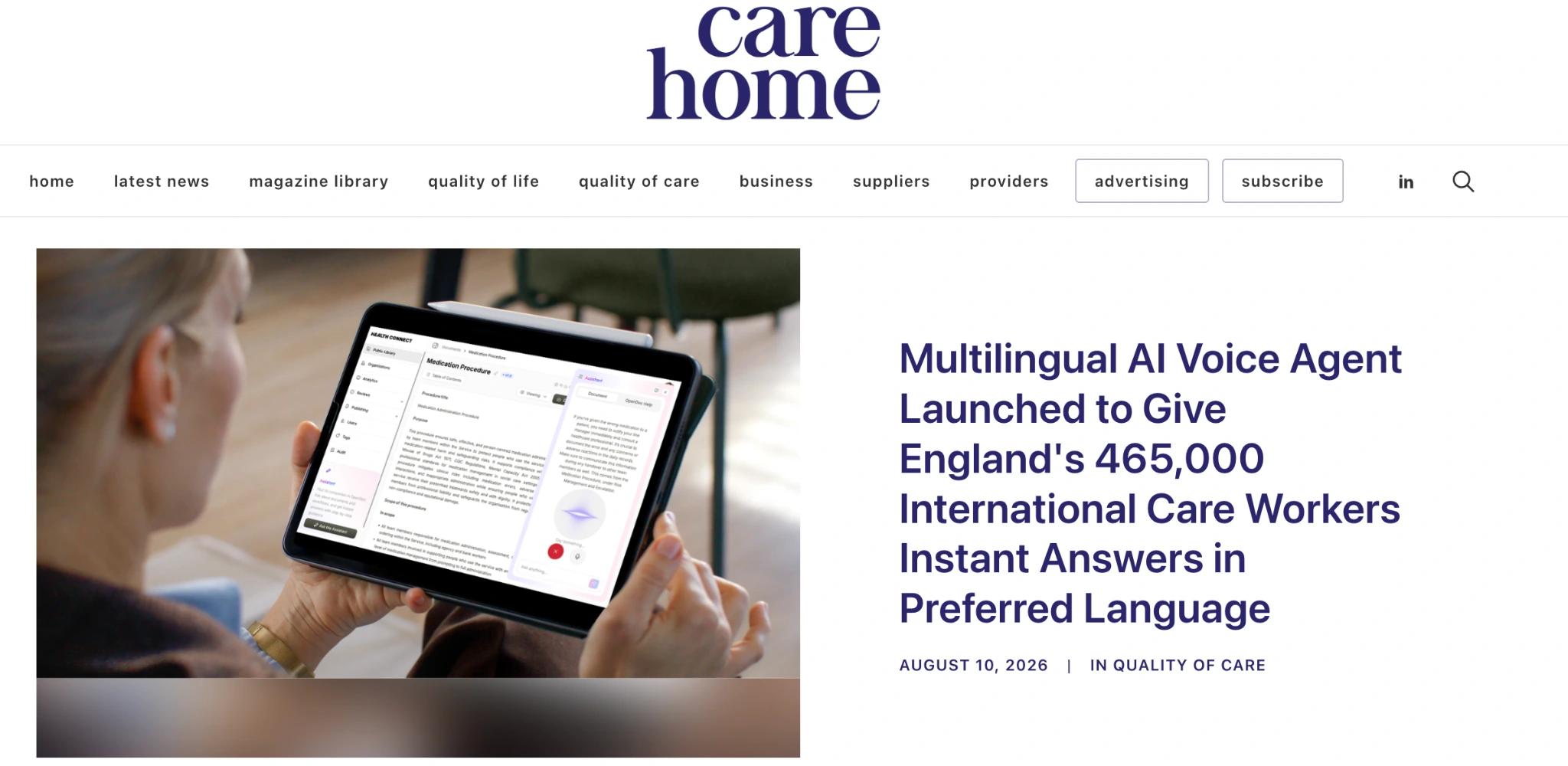
OpenDoc Voice
Experience a different approach to AI in care.
Already using OpenDoc? Log in
Artificial intelligence. Human authority.