
The World’s First Care Super Intelligence System
Care Intelligence
About Us





All Rights Reserved by Health Connect - 2026
How OpenDoc’s AI works
OpenDoc’s AI works from policies written and approved by named care experts, and from the versions your service has approved. Every answer links to its source. When your policies don’t cover a question, it says so and tells staff to check with their manager.
The short answer
Most AI assistants answer from whatever their model learned. OpenDoc doesn’t rely on that. It grounds every answer in a curated body of care knowledge: policies contributed by named care professionals and providers, each approved by at least three experts, and the versions your service has approved. People decide what the AI can draw on. The AI helps staff find it, in their own language, at the moment they need it.
How it works
Named care professionals and providers contribute policies. Each needs at least three expert approvals before it enters the public library.
You tailor policies to your service, or upload your own, and approve what your staff use.
By typing or speaking, in any of 51 languages, on a phone, tablet or computer.
From your approved policies, with a link to the policy. If the answer isn’t there, it says so.
What the AI does
Source-linked answers from your approved policies, by text or two-way voice in 51 languages.
Plain summaries so staff get the point of a policy fast.
Turns policies you upload, as PDFs or photos, into the expert community’s best-practice template.
Helps rewrite and personalise policies with your service’s details, with every edit recorded.
Flags relevant changes in CQC, NICE and Care Act guidance. Experts review them before the library changes, and you choose whether to accept.
Shows managers what staff ask and which sections they read, so supervision and training go where they’re needed.
What it won’t do
Glass-box AI
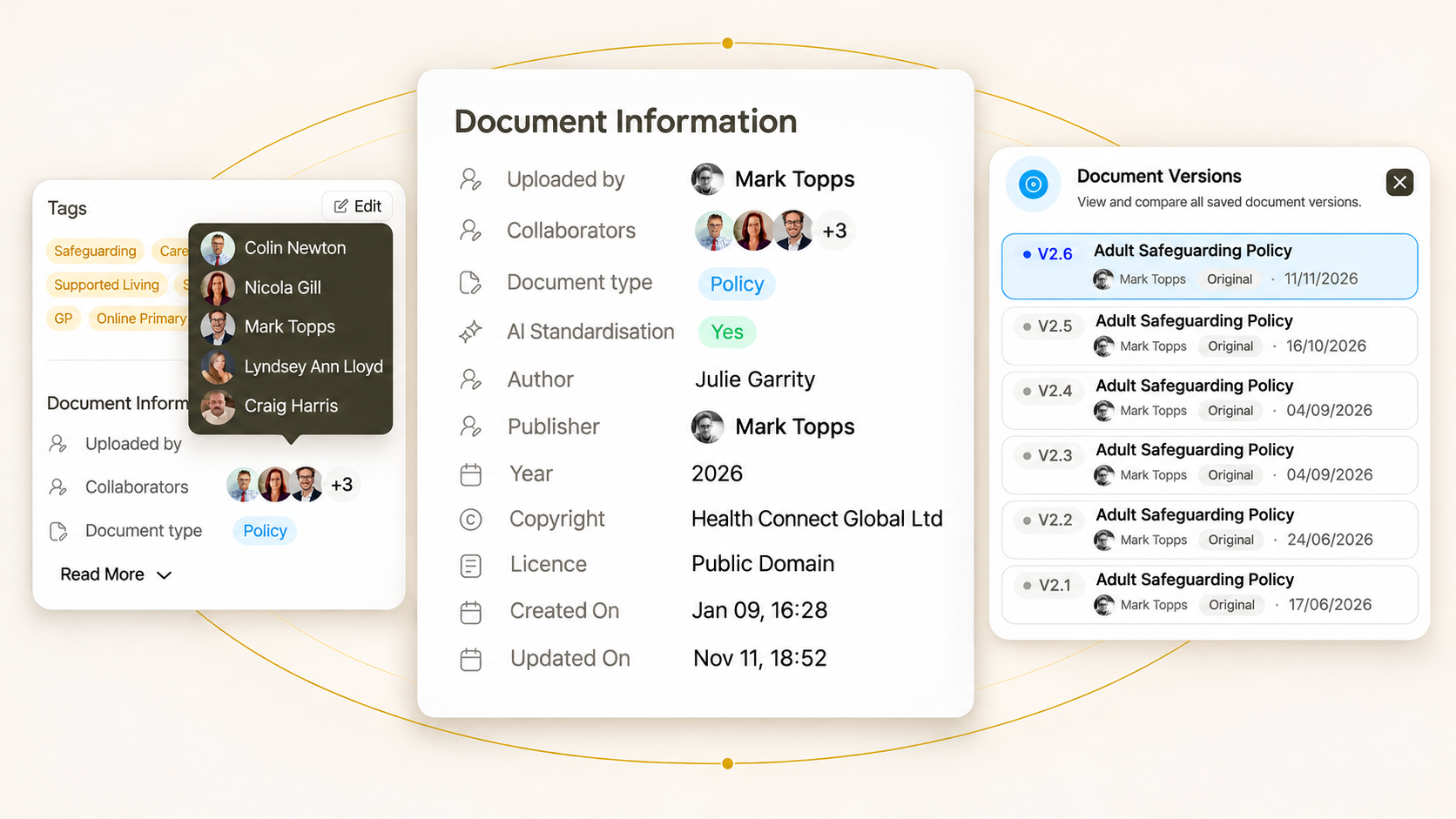
In OpenDoc’s public library you can see where each policy’s knowledge came from, who wrote and approved it, what was challenged, every dated version, and whether AI was involved. Nothing on that record can be altered, removed or backdated.
The research behind it
Health Connect researchers Dr Chané Moodley and Dr Devan Moodley set out the framework OpenDoc is built on: AI should support human-governed collective expertise in health and social care, not replace it.
Security
Health Connect holds Cyber Essentials Plus and meets the NHS Data Security and Protection Toolkit standards.
Questions
OpenDoc’s AI works from approved policies, not from general internet knowledge. Named care experts write and approve the policies in OpenDoc’s library, each care service approves its own versions, and the AI answers staff questions from those approved policies, with a link to the source. When the policies don’t cover a question, it says so and tells staff to check with their manager.
OpenDoc does not rely on what an AI model happens to know. It grounds every answer in a curated body of policy knowledge: policies contributed by named care professionals and care providers, each approved by at least three experts before publication, and the versions each service has approved locally. This is called source grounding. The experts shape what the AI can draw on, and every answer links back to the policy it came from.
OpenDoc is designed to answer only from your approved policies and to link to the source. If the policies don’t contain the answer, it says so and tells staff to check with their manager, rather than guessing.
It answers staff questions by text or two-way voice in 51 languages, summarises policies, standardises a provider’s existing policies into the expert community’s best-practice template, helps rewrite and tailor policies, and flags relevant changes in CQC, NICE and Care Act guidance for expert review. It also shows managers what staff ask, which reveals where a team is unsure.
Yes. Answers link to the approved policy they came from. In OpenDoc’s public library you can also see who wrote each policy, who contributed and approved it, what was challenged, every dated version, and whether AI was involved.
People do. Library policies need at least three expert approvals before publication, regulatory changes flagged by AI are reviewed by experts, and each care service approves its own versions. OpenDoc’s rules are set by its Expert Contributors under a ratified governance framework.
No. OpenDoc helps staff find what their own approved policies say, quickly and in their own language. Staff still use professional judgement and follow local escalation procedures.
Staff can ask questions and hear or read answers in 51 languages, by voice or text, on a phone, tablet or computer, with no app to install. OpenDoc Voice is included on the free plan.
Human-Augmented Collective Intelligence (HACI) is a framework by Health Connect researchers Dr Chané Moodley and Dr Devan Moodley. It argues that AI in health and social care should support human-governed collective expertise rather than replace it, through six principles: epistemic distribution, structured augmentation, collective validation, adaptive governance, traceable accountability and equitable accessibility. OpenDoc is built on those principles.
Health Connect holds Cyber Essentials Plus and meets the NHS Data Security and Protection Toolkit standards.
OpenDoc
