Care Talk reports on Health Connect Global's triple-blind study into AI-assisted care planning
An independent expert panel, co-chaired by former Health Secretary Steve Barclay MP and Phoebe Reynolds, is overseeing a nationwide evaluation of AI in social care.
Care Talk has reported on the launch of a triple-blind study by Health Connect Global, designed to evaluate whether artificial intelligence can help care professionals produce care plans that are more clinically accurate, person-centred and efficient.
Announced on 18 November 2026, the study invites thousands of care workers and clinicians across the United Kingdom to participate in a blinded assessment of care plans produced by AI and those written by care professionals.
The research represents an important development in the evidence-based evaluation of AI within social care, where the potential benefits of emerging technologies must be assessed against clinical safety, professional judgement and the needs of people receiving care.
Evaluating AI through professional judgement
The study examines three central measures:
- Clinical accuracy: Whether care plans accurately identify and address a person's clinical needs.
- Person-centred quality: Whether plans reflect an individual's circumstances, preferences and support requirements.
- Efficiency: Whether AI can help professionals produce comprehensive, high-quality care plans more efficiently.
Participants assess a selection of care plans without knowing whether they were generated by AI or written by care professionals. Each plan is scored using a defined evaluation matrix and the participant's own professional judgement.
The study is intended to provide evidence about the strengths, limitations and appropriate use of AI-assisted care planning, rather than relying solely on claims made by technology developers.
Independent oversight from across health and social care
Care Talk highlights the 16-member Independent Expert Panel established to oversee the research.
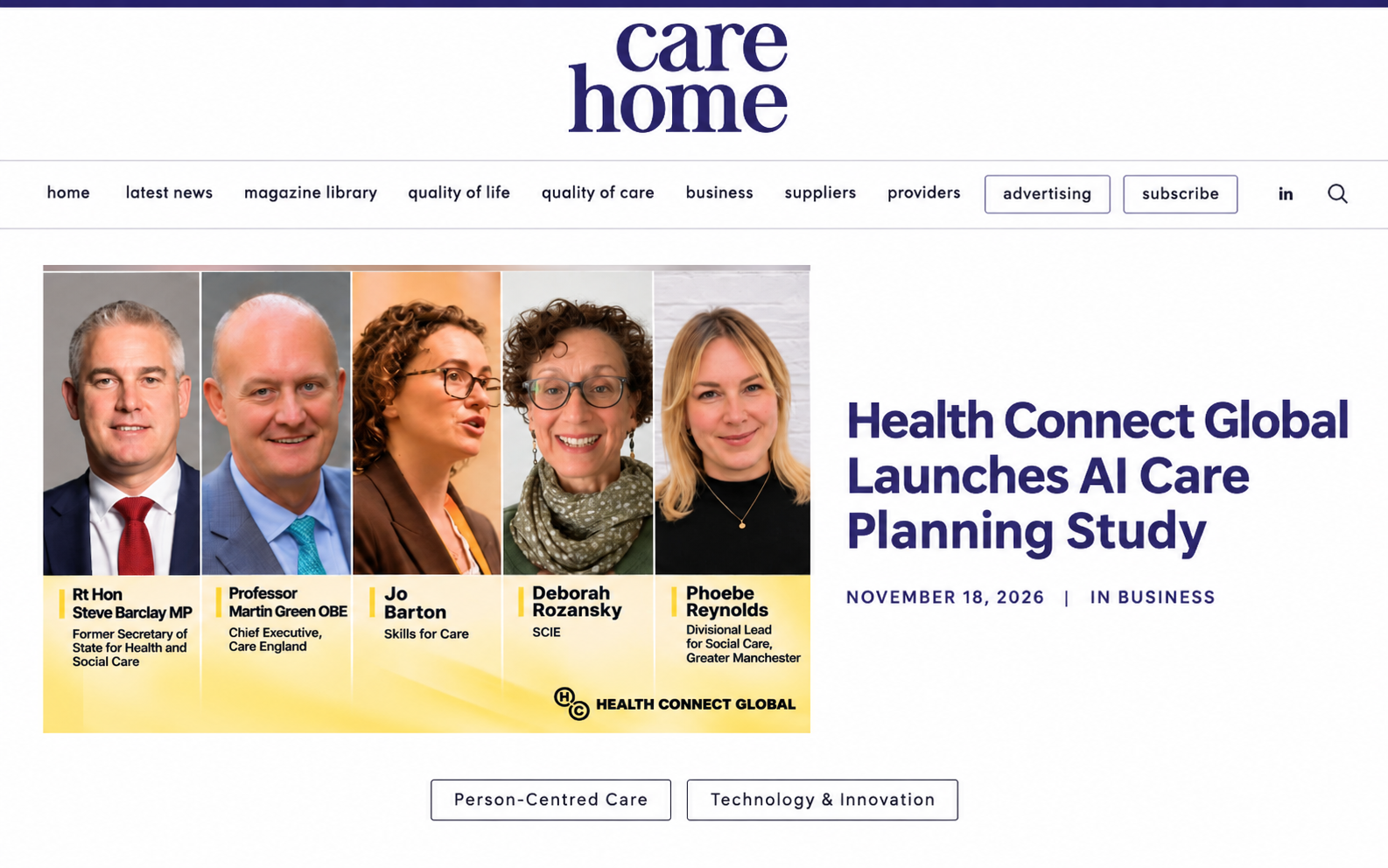
The panel is co-chaired by the Rt Hon Steve Barclay MP, former Secretary of State for Health and Social Care, and Phoebe Reynolds, Divisional Lead for Social Care in Greater Manchester and a practising Approved Mental Health Professional.
Its membership brings together experience spanning national health policy, adult social care, regulatory inspection, workforce development, clinical practice, academic research and AI.
Members identified in the coverage include:
- Professor Martin Green OBE, Chief Executive of Care England.
- Dr Jane Brightman of Skills for Care, who led the development of England's first adult social care Workforce Strategy.
- Deborah Rozansky, Director of Policy, Research and Information at the Social Care Institute for Excellence.
- Professor Craig Harris, Chief Commissioner of NHS Lancashire and South Cumbria Integrated Care Board.
- Eddie Hoult, a former adult social care inspector at the Care Quality Commission.
- Dr Radi Haloub, Director of Education at University College London's Global Business School for Health.
The panel's role is to provide independent scrutiny of the study's fairness, ethics and methodology, helping ensure that the resulting evidence can be critically examined by care professionals, sector leaders and regulators.
Addressing the administrative burden in social care
Care planning is an essential part of delivering safe, effective and individualised care. It is also a considerable administrative responsibility for frontline professionals.
Research reported by Health Connect Global indicates that care staff spend between 15 and 20 hours each week on manual administration and compliance-related work.
AI-assisted care planning has the potential to reduce elements of this burden by helping professionals organise available clinical information and develop structured, individualised plans aligned with relevant guidance.
However, the study recognises an essential distinction between supporting professional practice and replacing professional accountability.
Care professionals remain responsible for decisions about the people they support. The purpose of the evaluation is to determine whether AI can provide meaningful assistance while maintaining the standards of clinical accuracy, individualisation and safety expected in regulated care.
Research supporting medical device registration
Care Talk also reports that the study forms part of Health Connect Global's registration process with the Medicines and Healthcare products Regulatory Agency (MHRA).
This places the evaluation within the company's wider approach to clinical governance, evidence generation and the responsible development of healthcare technology.
The findings are intended to help establish where AI-assisted care planning can offer practical benefits, where limitations may exist and what safeguards are necessary before broader adoption.
Building evidence that care professionals can trust
In the Care Talk article, Dr Devan Moodley, Founder and CEO of Health Connect Global, emphasises the importance of properly testing AI and opening its performance to assessment by the professionals who will ultimately use it.
Steve Barclay identifies the administrative burden on social care as an area where AI may offer opportunities, while emphasising the need for credible evidence to support adoption.
Phoebe Reynolds highlights the importance of ensuring that technologies used in care planning respect the individuality of the people described in those plans and earn the trust of professionals and those receiving care.
Together, their contributions underline a central principle of the study: the quality and safety of AI in social care should be determined through structured evaluation, independent scrutiny and the judgement of people with direct care experience.
The study's findings have not yet been established. Its significance lies in opening the technology to systematic evaluation and making professional assessment a central part of determining its appropriate role in care.